Key Takeaways
- Evaluation Framework: Choose an agency on process, transparency and ownership, not on promises or price alone.
- Core Requirements: Ask for a written audit, a clear scope, live reporting and proof of white-hat methods.
- Deal Breakers: Walk away from guaranteed rankings, secret techniques and anything that withholds your data.
How do you choose the right SEO agency?
The right SEO agency is one that explains its process clearly, works only with white-hat methods, reports transparently and leaves you in full control of your accounts and data. To find one, define your goals, shortlist three to five providers, ask the twelve questions below and compare the answers side by side. The sections that follow show what a good answer looks like.
If you are still learning what the work involves, start with our complete guide to SEO services and then return here.
The questions are grouped around four themes: process, methods, transparency and ownership. If an agency struggles with any group, treat that as useful information before you commit.
What should you prepare before talking to agencies?
- Your goal: more leads, more online sales, or more brand visibility. Be specific.
- Your baseline: current organic traffic, enquiries and top pages from Google Search Console and Analytics.
- Your budget range and timeline: agencies can then recommend a realistic scope.
- Your competitors: two or three sites you want to outrank.
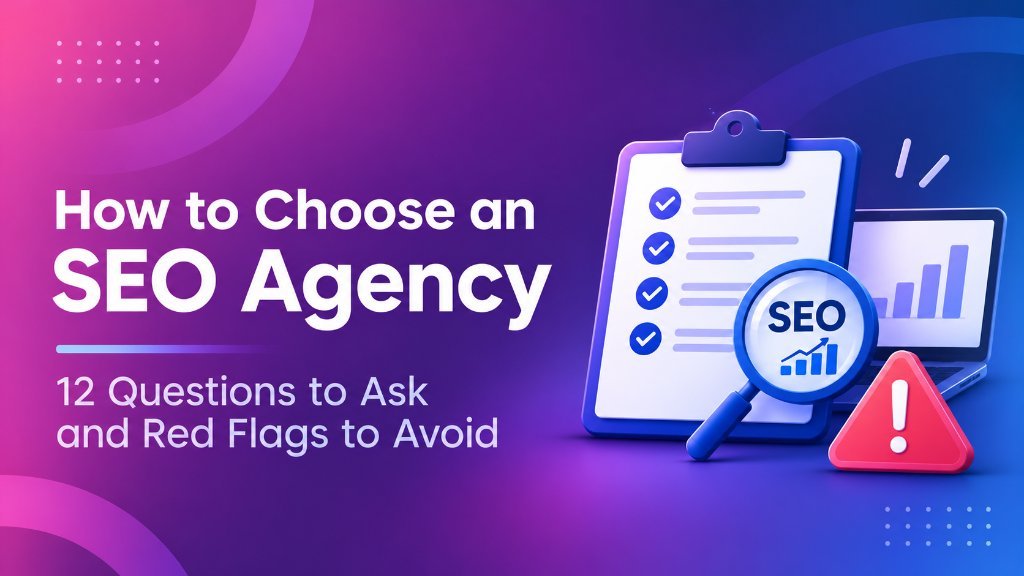
What are the 12 questions to ask an SEO agency?
1. What does your process look like in the first 90 days?
A good answer includes an audit, a prioritised roadmap, technical fixes first and content and authority work phased in. Vague answers about “optimising your website” are a warning sign.
2. Will you audit my site before proposing a plan?
Quality proposals are based on evidence. Ask whether the audit is included and what it covers, including technical health, content gaps and competitor analysis.
3. Which methods do you use to build links?
Look for digital PR, original research and editorial outreach. Avoid anyone who mentions link packages, private blog networks or guaranteed link counts.
4. How do you approach AI search visibility?
A modern agency should explain how it optimises for ChatGPT, Perplexity and Google AI Overviews as well as classic results. Our guide to SEO vs AI search optimisation shows what to expect.
5. Do you cover technical, on-page and off-page SEO?
Specialists can be excellent, but make sure all three areas are covered somewhere in the plan. Our breakdown of on-page, off-page and technical SEO explains why.
6. How will you report progress?
Ask for sample dashboards. Good reporting shows rankings, organic traffic, conversions and AI citations, and you should be able to access it live.
7. Who will actually work on my account?
Some agencies sell with senior people and delegate to juniors. Ask who writes, who handles technical work and who you will speak with each week.
8. How do you use AI in your content?
Google evaluates quality, not production method. The right answer is that AI supports research and structure, while subject experts write and review the final content with original insight.
9. Who owns the accounts, content and data?
You should. Insist on ownership of Search Console, Analytics, content and any assets created. If an agency holds these hostage, leaving later becomes costly.
10. Can you share relevant case studies?
Look for results in a similar industry or business model, with clear metrics and timeframes. Ask whether you can speak to a past client.
11. What are realistic timelines and expectations?
Honest agencies say technical gains can appear in weeks and sustainable growth usually takes three to six months. They will not guarantee exact rankings.
12. What happens if we decide to leave?
A confident agency has a clear exit process, with documentation and a handover of everything created. Contract lock-ins with penalties deserve scrutiny.
What are the red flags to avoid?
- Guaranteed rankings: no one controls Google’s results.
- Secret techniques: transparent methods have nothing to hide.
- Cheap bulk links: these create penalty risk.
- No access to your own data: you should always see your analytics.
- Unsolicited cold emails with generic audits: they rarely reflect real analysis.
- Long contracts with no performance review points: insist on regular checkpoints.
What are the green flags to look for?
- A clear roadmap tied to your business goals.
- Willingness to say what SEO cannot do.
- Content written by people with real subject knowledge.
- Regular check-ins and a named contact.
- Fast, well-built websites of their own, since an agency’s site is its own portfolio.
How should you compare proposals?
Use a simple scorecard so you compare like with like. Rate each agency from one to five on the areas below.
| Criteria | What to check |
|---|---|
| Audit and strategy | Written audit, prioritised roadmap, competitor analysis |
| Scope | Technical, on-page, off-page and AI search clearly defined |
| Methods | White-hat only, with examples of earned links |
| Reporting | Live dashboard, regular calls, plain-language summaries |
| Ownership | You own accounts, content and data |
| Evidence | Relevant case studies and references |
| Terms | Reasonable contract length and clear exit process |
Price matters, but it should be the last criterion rather than the first. A cheaper proposal with unclear deliverables often costs more in the end.
How should you think about pricing and contracts?
SEO pricing varies because scope varies. Agencies usually charge a monthly retainer for ongoing work or a fixed fee for a defined project such as an audit or migration. Instead of asking which agency is cheapest, ask what each fee includes: how many pages will be optimised, how much content will be produced, whether link building and AI search work are part of the scope, and how often you will receive reports. Two proposals with the same price can contain very different amounts of work.
On contracts, a short initial term with a review point after three months is a fair compromise, because SEO needs time but you should never feel trapped. Make sure the agreement states who owns the content, accounts and data, and what notice is required to end the engagement.
What should the first 90 days look like?
In the first two weeks you should receive access requests, an audit and a roadmap. By week six, priority technical issues should be fixed and key pages optimised. By month three you should see early movement in rankings and impressions, along with new content published and authority work underway. If you are not seeing a clear plan and progress updates by then, raise it directly.
Why consider Lead Stream?
Lead Stream’s SEO and AI optimisation service is built around the criteria above: a free initial consultation, a defined scope covering technical SEO, content, digital PR and AI answer auditing, live reporting dashboards, white-hat methods and full client ownership of data and accounts. You can judge us on the same twelve questions.
Put Our Framework to the Test
Ready to put us to the test? Book a free consultation and bring your list of questions.
Frequently asked questions
How long does it take to choose an SEO agency?
Most businesses need two to four weeks to shortlist, hold calls and compare proposals properly.
Should I choose the cheapest SEO agency?
Not automatically. Compare deliverables, reporting and ownership first. Low prices often reflect thin scope or risky tactics.
Is a local agency better than an overseas one?
Location matters less than expertise, communication and understanding of your market. Check time zone overlap and relevant experience.
Do I need a long contract?
Not necessarily. SEO takes months, so some commitment is reasonable, but look for review points and a clear exit process.
What should I give an agency to get started?
Access to Google Search Console, Analytics and your CMS, plus your goals and a list of competitors.
Can an agency guarantee first-page rankings?
No. Any such guarantee is a red flag. Ask instead for a defined process and measurable milestones.