Key Takeaways
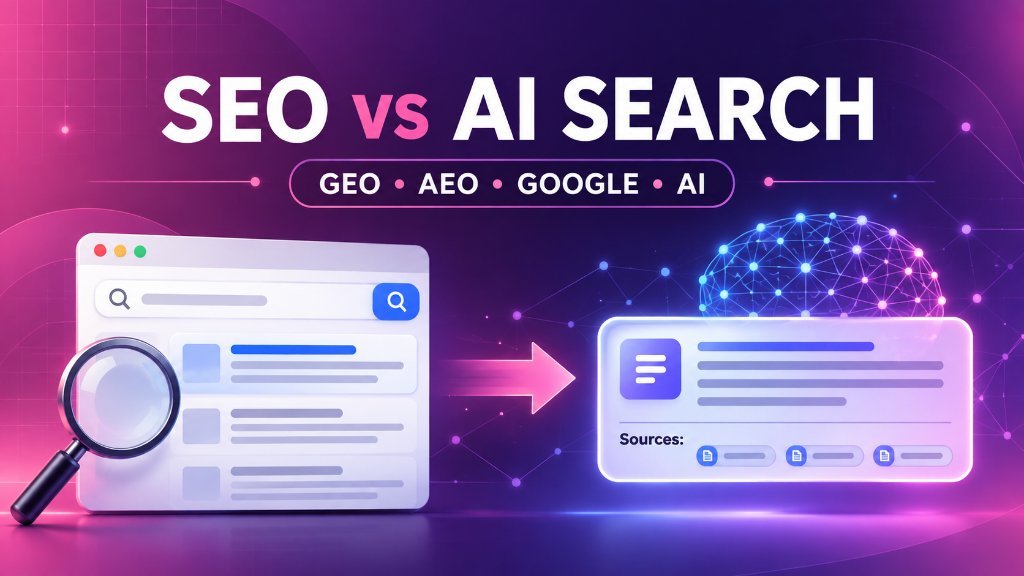
- Dual-Surface Visibility: SEO helps your pages rank in traditional search results. GEO and AEO help your content get found, understood and cited in AI-generated answers.
- Shared Core: The two share most fundamentals: helpful content, technical health and brand authority.
- The Core Difference: The practical difference is format and proof. AI tools favour clear answers, structured data and consistent mentions across the web.
- Repeatable Process: No one can guarantee AI citations, but you can raise your chances with a repeatable process.
What is the difference between SEO, GEO and AEO?
SEO (search engine optimisation) is the practice of improving your website so it ranks in search engine results pages. GEO (generative engine optimisation) is the practice of making your content easy for generative AI tools, such as ChatGPT, Perplexity and Claude, to retrieve and cite. AEO (answer engine optimisation) focuses on being the direct answer, whether in featured snippets, voice assistants or AI summaries.
In practice, the three overlap heavily. Treat GEO and AEO as extensions of a strong SEO programme rather than replacements for it. If you want the full picture of the underlying service, read our guide to SEO services.
| Attribute | Traditional SEO | GEO / AEO |
|---|---|---|
| Goal | Rank pages in results | Be cited or quoted in AI answers |
| Output the user sees | List of links | A written answer, often with sources |
| Key signals | Relevance, links, speed, intent match | Clear passages, entity consistency, third-party mentions |
| Success metric | Rankings, clicks, conversions | Citations, brand mentions, referral visits |
How is AI search different from Google search?
Classic search returns a ranked list and lets the user choose. AI search reads multiple sources, summarises them and presents one answer, sometimes with links. That changes what wins. A page can rank well and still be skipped by an AI summary if its answer is buried, vague or unsupported by other sources.
It also changes what you measure. Clicks matter, but so do mentions: whether your brand is named in an answer even when no click follows. Both signals feed pipeline, because buyers often meet your name in an AI answer before they visit your website.
Does traditional SEO still matter?
Yes. AI tools often retrieve content using search indexes, and pages that are slow, uncrawlable or poorly structured are less likely to be retrieved at all. Strong SEO also builds the authority and links that AI systems treat as trust signals. Our guide to technical, on-page and off-page SEO covers these foundations.
How do you optimise for AI search? Eight practical steps
1. Lead with the answer
Put a direct 40 to 60 word answer under the title and under each major heading. Follow it with detail. This format suits featured snippets and AI summaries alike.
2. Write self-contained passages
Each paragraph should make sense when quoted alone. Avoid unclear references such as “as mentioned above” and name the subject explicitly.
3. Use question-style headings
Headings that mirror real questions, such as “How much does X cost?”, match how people prompt AI tools. Research them using People Also Ask, forums and sales calls.
4. Add structure that machines can extract
Use bullet lists, numbered steps, comparison tables and short definitions. These are easy to parse and quote.
5. Implement schema markup
Use Article, FAQPage, Organization, Person and Breadcrumb schema where appropriate. Structured data helps machines understand who you are and what each page covers.
6. Strengthen entity consistency
Use the same brand name, service names and descriptions across your website, social profiles, directories and press mentions. Consistency helps AI systems connect the dots and recognise you as a distinct entity.
7. Build third-party mentions
AI tools do not rely on your website alone. Earn coverage through digital PR, original research, expert commentary, reviews and genuine participation in communities where your audience asks questions.
8. Keep content fresh and original
Update key pages regularly and publish original data, case studies and expert insight. Unique, citable facts give AI tools a reason to reference you instead of a competitor.
Should you allow AI crawlers on your site?
If you want visibility in AI tools, your robots.txt file should not block their crawlers. Common examples include GPTBot, PerplexityBot, ClaudeBot and Google-Extended, although each controls different uses, so review the documentation for each before deciding. Also confirm that important content is in plain HTML rather than hidden behind scripts or images. Some sites add an llms.txt file as a low-effort extra, but treat it as optional, since support varies and it is not a proven ranking factor.
How do you measure AI search visibility?
AI visibility is harder to track than rankings, so use several signals together:
- Run a fixed set of 20 to 30 target questions through ChatGPT, Perplexity, Gemini and Google AI Overviews each month and record whether your brand appears.
- Check referral traffic from AI platforms in Google Analytics 4.
- Watch branded search volume in Google Search Console, which often rises when AI mentions grow.
- Note which competitors are cited and which pages they use.
Track the same prompts over time and record the date, since AI answers vary between sessions.
What myths should you ignore?
- “SEO is dead.” The fundamentals still drive both rankings and AI retrieval.
- “You can trick AI tools with hidden text.” Manipulation tends to backfire and is against search guidelines.
- “AI-generated content ranks automatically.” Quality, originality and experience matter regardless of how a draft was produced.
- “One tactic guarantees citations.” No tactic does. Consistent quality and authority are what improve your odds.
What is a simple 30-day action plan?
- Week 1: audit your top ten pages for crawlability, speed and schema, and list your priority questions.
- Week 2: rewrite page openings with direct answers, add question-style headings and tidy up structure.
- Week 3: add FAQ sections and schema, and make brand details consistent across profiles.
- Week 4: start outreach for third-party mentions and set up monthly AI visibility tracking.
For a deeper programme, our guide to how to choose an SEO agency explains how to find a partner who covers both Google and AI search.
How Lead Stream helps
Lead Stream’s SEO and AI optimisation service combines technical SEO, high-intent topic clusters, authoritative digital PR and continuous AI answer auditing with JSON-LD schema tuning and entity linking. We track brand mentions and citations across major AI tools alongside Google rankings, so you see both surfaces in one report.
Audit Your AI Mentions
Curious whether AI tools mention your brand today? Book a free consultation and we will check.
Frequently asked questions
What is generative engine optimisation (GEO)?
GEO is the practice of structuring your content and brand signals so generative AI tools can find, understand and cite you in their answers.
Is AEO the same as GEO?
They are closely related. AEO focuses on providing direct answers, including snippets and voice results, while GEO focuses on generative AI tools. Most tactics apply to both.
Will AI search replace Google?
Nobody can say for certain. Both surfaces are used today, so a strategy that serves both is the safest approach.
How long does it take to get cited by AI tools?
It varies. Authority and mentions build over months, so treat it as an ongoing programme rather than a quick fix.
Do I need separate content for AI search?
No. Well-structured, genuinely helpful content serves both. The main change is answer-first formatting and stronger proof.
Can anyone guarantee a ChatGPT citation?
No. AI answers vary, and no provider controls them. Focus on quality, structure and authority, and track progress over time.