Key Takeaways
- Ongoing Programme: SEO services are an ongoing programme of technical, content and authority work that helps your site rank on Google and get cited in AI answers.
- Six Core Pillars: A complete service covers six areas: audit and strategy, technical SEO, on-page and content, authority building, AI search optimisation, and reporting.
- Realistic Timelines: Expect early technical gains in 3 to 6 weeks and compounding traffic growth in 3 to 6 months.
- Deliverables Over Price: Cost depends on scope, competition and site size, so compare proposals by deliverables rather than headline price.
What are SEO services?
SEO services are the ongoing work an agency or specialist does to help your website appear higher in search results and attract qualified visitors without paying for each click. SEO stands for search engine optimisation. In practice it means fixing how your site is built, improving what your pages say, and earning trust signals from other websites so that Google, and increasingly AI tools such as ChatGPT and Perplexity, treat you as a reliable answer.
Unlike paid ads, which stop delivering the moment you stop spending, organic rankings keep working and tend to compound over time. That is why SEO is usually among the most cost-efficient acquisition channels for businesses with a long-term view.
Why do SEO services matter in 2027?
Search now happens on two surfaces. People still type queries into Google, but they also ask full questions to AI assistants and read AI Overviews at the top of the results page. Both surfaces draw from the same pool of web content, and both prefer pages that are clear, trustworthy and well structured.
This means a modern SEO programme has two jobs: rank in classic results and be cited in AI-generated answers. Treating them as separate projects duplicates effort. The better approach is one strategy that serves both, which we explain in our guide to SEO vs AI search optimisation.
What do SEO services include?
A complete engagement usually has six components. Providers may name them differently, but if one is missing you should ask why.
1. Audit and strategy
Everything starts with an audit of your site, your competitors and your keyword opportunities. The output is a prioritised roadmap: what to fix first, which topics to target and which metrics define success. Be wary of any provider who skips this step and starts “optimising” immediately.
2. Technical SEO
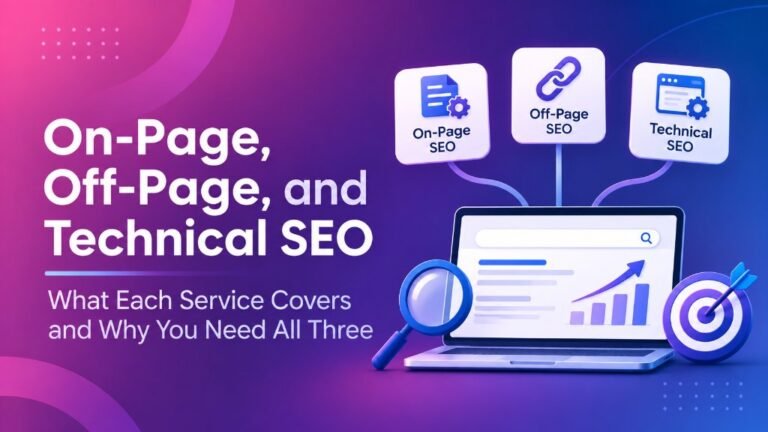
Technical SEO makes sure search engines can crawl, understand and index your site. It covers page speed, Core Web Vitals, mobile usability, site architecture, redirects, XML sitemaps, structured data and index management. Our breakdown of on-page, off-page and technical SEO explains each area in detail.
3. On-page SEO and content
This is the work done on the pages themselves: keyword research, title tags, headings, copy, internal links, images and schema. Content is built around topic clusters, where one main page is supported by related articles, so your site demonstrates depth on a subject rather than relying on a single keyword.
4. Off-page SEO and authority building
Search engines and AI tools both look for evidence that other people trust you. Off-page work includes earning editorial backlinks, digital PR, brand mentions, directory listings and reviews. Quality matters far more than quantity, and shortcuts such as private blog networks create real penalty risk.
5. AI search optimisation
Also called generative engine optimisation (GEO) or answer engine optimisation (AEO), this work structures your content and brand signals so AI tools can find, understand and cite you. It includes answer-first writing, schema markup, consistent brand naming and regular monitoring of where you are mentioned.
6. Reporting and ongoing optimisation
SEO is never finished. Good providers share regular reports covering rankings, organic traffic, conversions and AI citations, then use the data to adjust priorities every sprint.
How does an SEO engagement work?
Although every project is different, most follow the same five phases.
| Phase | What happens | Typical timing |
|---|---|---|
| Discovery and audit | Access to Search Console, Analytics and your CMS; full site, competitor and keyword audit | Weeks 1 to 2 |
| Technical foundation | Fix crawl, speed, indexation and schema issues | Weeks 2 to 6 |
| Content and on-page | Publish and optimise priority pages and topic clusters | Month 2 onward |
| Authority building | Digital PR and editorial link outreach | Month 2 onward |
| Measure and refine | Review data, update content, expand into new topics | Ongoing |
How long does SEO take to work?
Technical fixes such as speed, schema and indexation improvements typically show results within 3 to 6 weeks. Sustainable growth in organic traffic and enquiries usually takes 3 to 6 months, and highly competitive industries can take longer. Anyone who guarantees a number one ranking within weeks is either targeting a trivial keyword or putting your site at risk.
The upside of this timeline is durability. Pages that rank continue to bring visitors month after month, and each new piece of content strengthens the rest of your site.
What do SEO services cost?
Pricing varies widely because scope varies widely. Three models are common:
- Monthly retainer: a fixed fee for an agreed scope each month, best for ongoing growth.
- Project-based: a one-off fee for an audit, migration or content build.
- Hourly or consulting: useful for advice or training, less suited to full execution.
The main factors that change the price are the size and condition of your website, the competitiveness of your market, how much content is needed, how much link building is required, and whether AI search optimisation is included. Rather than comparing headline prices, compare deliverables, reporting and who owns the work. Our guide to choosing an SEO agency lists the questions to ask before you sign.
Who needs SEO services?
SEO suits any business whose customers search online. B2B software, e-commerce, healthcare, legal and advisory, real estate, education, manufacturing, logistics and hospitality all benefit. It is especially valuable if you rely heavily on paid ads, because organic traffic lowers your blended acquisition cost over time. If your site is new or has never been audited, a technical and content review is the best first step.
How do you tell good SEO services from bad ones?
Look for these signs of a trustworthy provider:
- A written audit and roadmap before work begins.
- Live reporting you can access yourself.
- White-hat methods only, with no purchased links.
- Full ownership of your accounts and data stays with you.
- Honest timelines instead of guaranteed rankings.
Red flags include secret methods, no access to your own analytics, and bulk low-quality links. The full list is in our guide to how to choose an SEO agency.
How Lead Stream approaches SEO
Lead Stream’s SEO and AI optimisation service combines technical SEO and Core Web Vitals engineering, topic-cluster content built around buyer intent, authoritative digital PR and continuous AI answer auditing. Reporting runs through live dashboards, and you keep full ownership of your data and accounts. Your first consultation is free.
Map Your Search & AI Plan
Want to know where your site stands? Book a free SEO consultation and we will map a plan for Google and AI search.
Frequently asked questions
What is included in SEO services?
A full service includes an audit and strategy, technical SEO, on-page optimisation and content, authority building, AI search optimisation and regular reporting.
How much do SEO services cost?
Cost depends on your site size, market competition and scope of work. Most agencies price by monthly retainer or by project. Ask for a scoped proposal with clear deliverables.
How long before I see results from SEO?
Technical improvements often show within 3 to 6 weeks. Meaningful traffic and lead growth usually takes 3 to 6 months.
Can I do SEO myself?
Yes, for small sites with simple needs. As competition, site size or technical complexity grows, a specialist team saves time and avoids costly mistakes.
Do SEO services include AI search optimisation?
They should. AI tools and Google draw on the same content, so structuring pages for citation is now part of a complete SEO programme.
Can anyone guarantee rankings?
No. Search engines do not allow anyone to buy guaranteed positions. Reputable providers commit to process, transparency and measurable progress instead.